Best IPTV for Portugal: How Tech-Savvy Fans Stream Live Football in 4K Without Cable
You know the feeling. It's the 89th minute of a Champions League knockout tie, your stream freezes, the spinning circle of doom appears, and by the time the picture returns the goal has already been replayed three times on social media. If you're the kind of person who reads gadget reviews and obsesses over bitrates, refresh rates and Wi-Fi 6 routers, that moment is not just annoying — it's a personal insult.
This is exactly where the thematic bridge between consumer tech and live sports becomes obvious. The same audience that hunts for the best budget 4K TV, the fastest streaming stick and the cleanest mesh network is the audience that demands flawless live football. IPTV — Internet Protocol Television — is the technology that finally marries those two worlds, and a sports-first provider like RasFox IPTV is what turns a smart TV in a Lisbon apartment into a front-row seat at the Estádio da Luz.
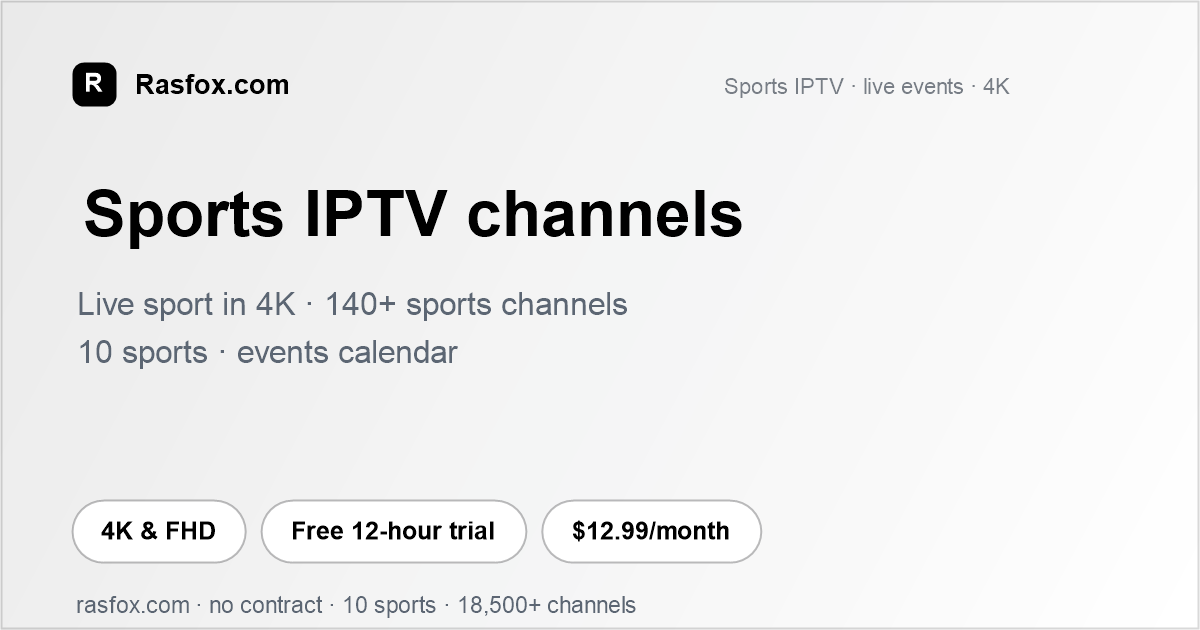
What Is IPTV — And Why Does It Beat Cable for Live Sports?
IPTV delivers television channels over your internet connection instead of a satellite dish, coaxial cable or antenna. Instead of a set-top box tuned to a specific frequency, you get a data stream that a player app decodes on your device. That's the simple version. The technical version involves H.264/H.265 encoding, adaptive bitrate streaming and CDN distribution — but you don't need a networking degree to enjoy it.
What matters for a sports fan is the practical difference:
- Lower latency: a well-run IPTV service can push live football with delay measured in a couple of seconds, not the 30–60 seconds typical of some satellite feeds.
- Real 4K: premium providers now broadcast at 4K 50FPS, which means smooth motion on fast pans and no judder when the ball is whipped across the box.
- Massive choice: RasFox carries around 12,000 live channels and 40,000 on-demand titles, so a Portuguese fan can flip between Liga Portugal and the Brasileirão without switching subscriptions.
- No long contracts: you're not locked into an 18-month cable bundle just to get Sport TV.
The Tech Behind a Smooth Stream
Three things determine whether your IPTV experience feels like a stadium or a slideshow: your internet speed, your network hardware and the quality of your provider's servers. A stable 25 Mbps connection handles 4K comfortably; 10–15 Mbps is plenty for 1080p at 50/60FPS. After that, it's all about the provider's infrastructure — and this is where cheap, oversold services fall apart during a Benfica vs. Porto derby.
From Living Room Gadget to Stadium: IPTV Inside Your Tech Setup
If you already own a smart TV, a streaming stick or a games console, you own an IPTV client. That's the beauty of the format: IPTV is hardware-agnostic. The same app you use for Netflix can, in many cases, run an M3U playlist or an Xtream Codes login.
For the gadget-obsessed reader, here's how IPTV slots into a typical modern setup:
- Smart TV (Samsung Tizen, LG webOS, Android TV): install a player from the store and you're done in three minutes.
- Amazon Fire TV Stick 4K Max: arguably the best value IPTV client on the market — fast, cheap, and supports 4K HDR playback.
- Nvidia Shield / Android boxes: the enthusiast's choice, with hardware decoding that keeps 50FPS streams buttery smooth.
- Apple TV 4K: elegant, responsive, and perfect for households already inside the Apple ecosystem.
- PC, Mac and even phones: ideal for watching the second half on the train home.
The catch? A great client on a weak network still buffers. If you're serious about live sports, treat your router like gear: use 5 GHz Wi-Fi or Ethernet, and keep the TV off the congested 2.4 GHz band. That single change eliminates most of the "IPTV always freezes" complaints you see in forums.
The Sports-First Difference: RasFox and the Radio Malena Legacy
Most IPTV sellers are generic resellers with a spreadsheet of channels. RasFox is different, because it grew out of a sports and culture broadcaster: Radio Malena 89.1 FM, Buenos Aires (Venezuela 370) — a station with deep roots in tango and Argentine cultural tradition. That heritage matters. A team raised on live commentary, match analysis and the rhythm of the terraces doesn't build a service around reality TV reruns. It builds one around live sport.
Today, that sports-first philosophy serves lusophone and Latino communities worldwide. Roughly 80% of the catalogue's energy goes into sports channels and live events, with the rest filling the gaps for family viewing.
Sports Channels Available for Portuguese Viewers
- Sport TV 1–6 — the backbone of Portuguese football coverage
- Eleven Sports — Premier League, La Liga and MotoGP action
- Benfica TV and Porto Canal — club-dedicated coverage and B-team matches
- DAZN Portugal — boxing, combat sports and select football rights
- Eurosport — cycling grand tours, tennis and winter sports
Beyond Portugal, the same subscription opens global sport: ESPN, DAZN, Sky Sports, beIN Sports, Fox Sports, SuperSport, TyC Sports, Globo, SporTV, Premiere, ESPN Brasil. That means Brasileirão, Copa Libertadores, the Champions League, Liga Portugal, La Liga, the Premier League, F1 and UFC — all in one interface.
Key takeaway: for a Portuguese speaker, RasFox is essentially a "Liga Portugal + Champions League + Brasileirão" bundle with 11,000 other channels attached as a bonus.
IPTV in Portugal: Market, Internet and Local Realities
Portugal is a genuinely strong market for IPTV, and not by accident. The country has some of the best fibre coverage in Europe — MEO, NOS, Vodafone and NOWO have pushed FTTH into both Lisbon and Porto and into smaller towns like Braga, Aveiro, Leiria and Faro. If you can get 200 Mbps fibre for the price of a couple of coffees, the bandwidth question is solved.
The second factor is cost. Traditional pay-TV bundles in Portugal are expensive, particularly when you add premium sports tiers. For a family that only truly cares about football, that's a lot of money spent on channels nobody watches.
Third — and this is the part the tech press often skips — the Portuguese-speaking diaspora is enormous. Whether you're in Lisbon, Geneva, Toronto, Luanda or São Paulo, the desire is identical: ver futebol em direto, in Portuguese, without hunting for a sketchy stream at 2 a.m. IPTV solves a genuinely global problem.
What Portuguese Fans Actually Search For
- Where can I watch Liga Portugal live without a cable package?
- Is there an IPTV service with Sport TV included?
- How do I stream the Champions League in 4K?
- Can I watch Brasileirão from Portugal?
A sports-focused service like this sports-focused IPTV provider answers all four in a single subscription — which is precisely why the model has grown so fast across lusophone markets.
Hardware and Setup Guide for Portuguese Cord-Cutters
Setting up IPTV takes about as long as installing a new phone. Here's the practical path:
- Check your connection. Run a speed test next to the TV, not next to the router. Aim for 25 Mbps+ for 4K, 15 Mbps for stable 1080p.
- Pick your device. Fire TV Stick 4K Max for budget, Nvidia Shield for performance, Apple TV 4K for polish, or just the smart TV you already own.
- Install an IPTV player app. Popular choices include IPTV Smarters, TiviMate, and XCIPTV — all support Xtream Codes logins and M3U playlists.
- Enter your credentials. Username, password, and server URL. Two minutes, done.
- Test before you commit. A serious provider offers a 24-hour free IPTV trial so you can stress-test it during an actual live match — the only honest benchmark.
Pro tip for gadget lovers: if you run a mesh Wi-Fi system, wire the main node to your router and connect the TV box to Ethernet if possible. IPTV is a live, constant-bitrate stream — it punishes weak Wi-Fi far more than on-demand video does.
One more feature worth noting: RasFox supports 2 simultaneous screens. That means the main TV can show the Primeira Liga while a tablet streams UFC or F1 in the kitchen — no arguments, no extra subscription.
Legal vs Illegal IPTV: How to Stay on the Safe Side
Let's be direct, because this is where a lot of readers get misled. IPTV as a technology is completely legal — it's just television delivered over the internet. What varies is the licensing of the content being distributed.
In Portugal, as across the EU, the legal framework is clear:
- Legal: services that hold proper distribution rights, operate transparently, publish terms of service, and charge a realistic price.
- Illegal: anonymous sellers on forums, suspiciously cheap "lifetime" plans, no support, no refund policy, no identifiable company.
Red flags to avoid: prices that make no economic sense, payment only via untraceable crypto with zero contact info, no trial period, and apps that require you to disable security features.
When choosing a provider, look for the boring, reassuring signals: a real website, an actual support channel (RasFox offers Portuguese and Spanish speaking support), a legitimate trial, and clear billing. You can review the service and its terms directly at the official RasFox IPTV website before spending a cent.
Bottom line: choose a provider that behaves like a business, not like a ghost. That protects your device, your payment details and your peace of mind.
Verdict: Is IPTV the Right Move for a Portuguese Sports Fan?
If you're a tech-minded viewer who wants live football in genuine 4K 50FPS, a huge channel list, zero long-term contracts and the freedom to watch on whichever gadget is closest, IPTV is no longer a compromise — it's the better option. The old argument ("IPTV always buffers") belongs to 2015. With fibre internet, modern hardware and a provider engineered around sport, the experience is cleaner than most cable boxes.
The combination that matters here is simple: sports-first infrastructure + lusophone support + flexible hardware + no contract. RasFox checks all four, with 12,000 channels, 40,000 VOD titles, two simultaneous screens and a free 24-hour trial that lets you verify everything on match day.
Start with the trial, run it during a live Champions League or Liga Portugal fixture, and judge for yourself. If it holds up under pressure, you've just replaced an expensive cable bundle with something faster, sharper and far more flexible. Start your 24-hour free IPTV trial here.
FAQ: IPTV in Portugal and Live Football Streaming
1. Can I watch Liga Portugal and the Champions League with IPTV?
Yes. A sports-focused IPTV service carries channels such as Sport TV 1–6, Eleven Sports and DAZN Portugal, which cover Liga Portugal, the Champions League, La Liga, the Premier League and Formula 1. Always confirm current channel listings with your provider before subscribing.
2. What internet speed do I need for 4K IPTV?
Around 25 Mbps of stable bandwidth per 4K stream is the comfortable target. For 1080p at 50FPS, 10–15 Mbps is usually enough. Stability matters more than raw speed — a steady 30 Mbps beats a fluctuating 300 Mbps.
3. Which device is best for IPTV in Portugal?
For most households, an Amazon Fire TV Stick 4K Max offers the best value. Enthusiasts who want hardware decoding and maximum smoothness tend to prefer the Nvidia Shield or a dedicated Android TV box. Apple TV 4K is excellent if you're already in the Apple ecosystem.
4. Is there a free trial available?
Yes — RasFox offers a 24-hour free trial so you can test real live sports streams on your own network before committing. That's the only reliable way to judge a provider's server quality.
5. How many devices can I use at the same time?
RasFox supports two simultaneous screens on a single subscription, which covers a main TV plus a phone, tablet or second television — ideal for households where football and combat sports clash on the same evening.
6. Does IPTV work outside Portugal?
Absolutely. The service is built for lusophone and Latino communities worldwide, so Portuguese expats in Switzerland, the UK, Canada, Angola or Brazil can watch home football and Brazilian league matches without a local cable contract.